









![[ Iήsͥⱥnͣeͫ ] profile picture](https://fixofelix.com/wp-content/uploads/2026/09/ChIJy25GrAltXz4Ra_1PGefILCw_74e1b40ac496bca67ffa20df513c72ce.jpg)









What your AMC actually covers, and where covered ends.
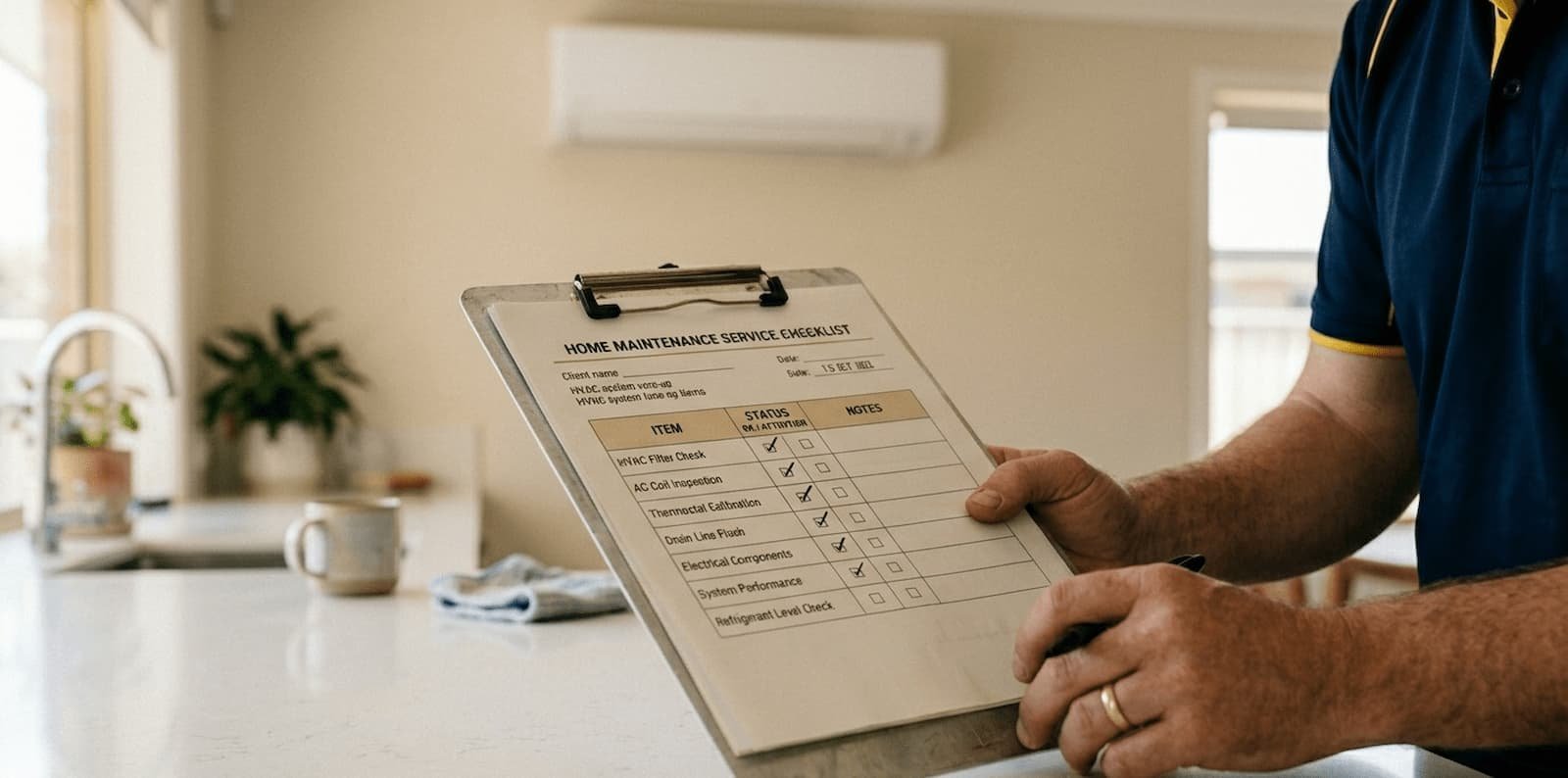
What does an AMC actually cover? Three kinds of work, in three different ways: knowing which is which tells you exactly what happens when you call, and what lands on the invoice. A villa owner messaged us about a bad smell coming from his ducted AC. We talked through the inspection and the hourly rate, and then, before booking anything, he asked the question most people are turning over in their heads but don’t always say out loud: “If the job requires you to bring materials, so you need another visit, will you charge me again?” A few messages later, having sat with the adhoc maths for a moment, he asked the second one: “You do service contract?” What he was really asking, across both questions, is the thing nobody quite spells out when they sell you an AMC. When I’m on a contract and something happens, what’s actually covered? What comes free, and what still shows up on a bill? It’s a fair question, and the answer is clearer than most providers make it sound. An AMC covers three different kinds of work, and it covers each of them in a different way. Once you can see the three, the whole thing stops being vague. The first kind: reactive callouts This is the part people underestimate before they own a contract, and the part they value most once they do. Something breaks, you call, a technician comes out and fixes it, and the labour is included. No per-visit charge, no hourly meter running while they work. Across all tiers, these callouts are unlimited. That’s the engine of the contract. Not the scheduled servicing, not the discounts, but the simple fact that when something goes wrong you make one call and the labour to put it right is already paid for. Parts, if a repair needs them, are billed separately, and we’ll come back to exactly where that line sits later on. What changes from one callout to the next isn’t whether it’s covered. It’s how fast we’re contracted to be there, and that depends on whether the problem is an emergency or not. What counts as an emergency An emergency is something that makes the home unliveable, or that’s actively causing damage while you wait. The contract sets a fast response clock for these: 120 minutes on Silver, 90 minutes on Gold and Platinum, around the clock, every day of the year. Emergency: immediate response Non-emergency: same day Total AC failure, or no cooling at all in summer heat. An active leak flooding a room, or no water to the whole property. Complete loss of power to the villa, or to a full floor. A burning smell, a spark, any sign of an electrical fire. Sewage backing up into the home, or a water tank overflowing into the community where it can draw fines. (90–120 min response, 24/7) A single AC unit not cooling, or making a noise. A contained drip or low pressure at one fixture. A blocked drain that isn’t flooding. A few sockets out, or one circuit tripping. (Same-day response; 6 hr on Platinum) The dividing line is roughly that simple. Is the home unliveable, or is something getting damaged right now? That’s an emergency. Is it genuinely annoying but able to wait until later today? That’s a non-emergency, and it still gets a same-day response, just not the 90-minute clock. And you don’t have to make that call yourself. Where the line between emergency and non-emergency sits is something we’ve thought carefully about and set out clearly, so it’s applied consistently and fairly rather than decided on the spot. You call, you tell us what’s happening, and we place it for you against that same standard everyone gets. Flag anything you’re unsure about; that’s exactly what the call is for. The second kind: the scheduled visits (your PPM) The reactive callouts handle things once they’ve gone wrong. The scheduled visits are the half of the contract built to stop them going wrong in the first place. These are your planned preventive maintenance visits, the PPM you’ll see named in the contract and on your service reports. AC servicing on a set cadence through the year, plus plumbing and electrical inspections that clean, check, and tighten before anything fails. They happen on a calendar, so they get done whether or not you remember to book them, which on adhoc is usually the thing that quietly never happens. We’ve written separately on why preventive maintenance pays for itself in Dubai and what a visit actually covers, so we won’t repeat it here. For the purposes of what’s covered: the labour and the visit itself are included in your fee. It’s covered work, on a schedule, included. The third kind: covered at a discount, not for free This is the one most worth understanding before you sign, because it’s where “covered” quietly changes meaning. Some work isn’t included in the fee at all. Instead it’s offered at a discounted rate to contract clients. Covered, in the sense that you get a better price, but not free. Two things sit here. The first is out-of-scope handyman work: furniture assembly, picture hanging, larger painting jobs, the general tasks outside the three core trades. These run at the standard hourly rate with your tier discount applied, 10 to 20% depending on the contract. The second is the major AC service, the deep chemical clean a unit needs when it’s heavily fouled. It isn’t a free scheduled inclusion. Your contract gets you a discount on it, scaled by tier, but the work itself is quoted and approved separately when a technician identifies that a unit needs it. The full list of what sits outside the fee, from parts through to structural work, is laid out in the cost guide. The point for here is just the principle: this third bucket is discounted, not included, and it’s worth knowing which bucket a given job falls into before you assume it’s free. Where what an AMC covers actually ends

When an AMC is the wrong choice for you
Do you need an AMC in Dubai, or are you about to sign an annual maintenance contract your home does not actually need this year? Bottom line: An AMC is worth it when your home needs enough regular attention that catching problems early and having one predictable cost helps. For plenty of Dubai homes it does, for others it quietly does not. We would rather tell you which group you are in than sign you up anyway. Here are the cases where we would tell you to wait. An AMC is probably not worth it this year if: An AMC genuinely earns its price if: The rest of this post explains each case, so you can place your own home. The question “do I need an AMC in Dubai” has a real answer, and for a meaningful share of homes the answer is not yet, or not this year. Knowing which group you are in before you sign matters more than any discount. The real value of an AMC is not that you come out ahead on repair bills. It is that someone is looking at your home on a schedule, so the small things get caught before they grow into the expensive ones, and a fixed annual cost replaces the unpredictable invoice that lands at the worst moment. For a home that needs that kind of steady attention, the peace of mind is worth paying for on its own. For a home that genuinely does not, you are paying to protect against problems it was never likely to have. This post is about working out which home is yours before the money changes hands. Where the pure cost comparison tips in favour of a contract is a separate question, and we have set out that maths in our guide to when an AMC starts to make sense. It is about something simpler: whether your home makes a contract worth having this year. So here are the situations where an AMC is probably the wrong call for you right now. None of them mean an AMC is a bad product. They mean it is the wrong product for your home this year. If you recognise your home in one of them, the useful move is to wait, not to sign. Your property is new and still under developer warranty If you have just taken handover of a new apartment or villa, most of what could go wrong in the first year is already someone else’s responsibility. Developers and equipment manufacturers carry warranties on AC units, water heaters, and major systems, often for the first twelve months and sometimes longer. An AMC does not replace that cover. It is worth being plain about this, because it works against us. Our own contract excludes warranty repairs on equipment still under developer or manufacturer warranty. For a brand new home, an AMC would be charging you to stand next to equipment that someone else is already obliged to fix. The better move is to note when your developer warranty ends, keep the handover documents safe, and look at an AMC as that cover runs down and the equipment moves onto your account. A new home in its first year is the clearest case where waiting costs you nothing, because the cover you would be paying for already exists elsewhere. You have a small home, one AC unit, and light use AMC pricing tracks the number of AC units, because those units are the main driver of maintenance work in a Dubai home. A compact apartment with a single split unit, lightly used because you travel often or cool the place only in the evenings, simply does not generate much work over a year. For a home like that, two or three ad hoc service visits a year may cost less than the contract. The maths is not the point of this post, and our pricing breakdown covers it if you want numbers. A small, low demand home is the profile least likely to need the steady attention a contract is built to provide. If that sounds like your home, there is no harm in starting with a single inspection and service, then deciding. You can always move to a contract later, and light use this year does not lock you out of cover next year. You are genuinely handy and already have trades you trust Some owners change their own AC filters, know which plumber to call, have a reliable electrician saved in their phone, and are comfortable managing all of it themselves. If you have built that network over years and it works, an AMC is buying you something you have largely already arranged for yourself. What a contract adds in that case is mainly convenience and a guaranteed response time, rather than access you lack. That can still be worth paying for if your time is scarce, but if your contacts are solid it is a smaller upgrade for you than for someone starting from nothing. The real test here is whether you actually use that network or just believe you have it. If the plumber you trust last worked for you three years ago, you may be less covered than you think. You are selling soon, your lease is ending, or you are leaving Dubai An annual contract assumes you will be in the property for the year. If you are listing the place in a few months, coming to the end of a tenancy, or planning to leave Dubai, that assumption does not hold, and a twelve month commitment is the wrong shape for your situation. There is a distinction worth drawing here. If you are leaving Dubai or selling up entirely, the contract can be cancelled: we keep a 25% retainer and refund 75% of the unused period, worked out monthly. So it is not a disaster, but paying in, drawing little, and cancelling for a partial refund is worse than not signing at all. If instead you are moving within
Why home maintenance in Dubai costs what it costs.
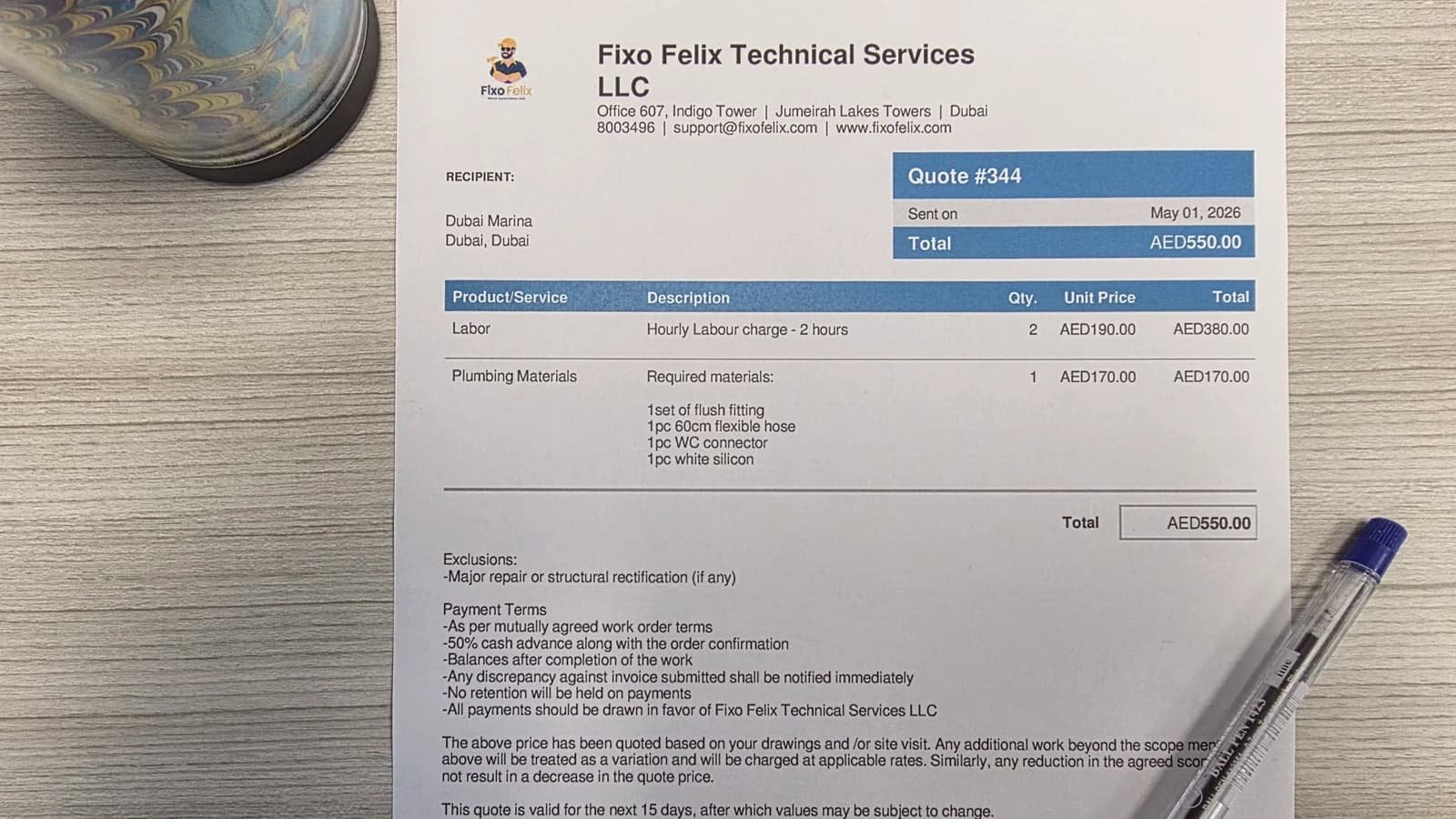
Why home maintenance in Dubai costs what it costs. The AED 190/hour breakdown, the Fix-it-Twice cycle, and the math behind why “cheap” usually means twice. Here’s a scene from this March. A villa owner in Al Furjan messaged us about a persistent bad smell coming from his master bathroom floor drain. He’d used us before — quick plumbing job at the same villa a few weeks earlier. He’d paid happily and even asked for the technician’s name to give him direct feedback (“he was very good”). The kind of repeat customer maintenance companies in Dubai dream about. This time we quoted our standard rate: AED 190 per hour. His reply: “It was 110 last time.” It hadn’t been. It had been AED 150. We told him that. “Ok so why can’t it be the same this time?” That’s the conversation most Dubai maintenance companies don’t bother to have — it’s easier to either lose the job or quietly drop the price and absorb the margin. So instead, we’re going to have it properly, in writing, once. This is why an hour of our work costs what it costs, why prices change, and how to tell — when you’re sitting in front of three quotes for the same job — which one is the fair one. The AED 190/hour rate, broken down Our standard labour rate is AED 190 per hour, Saturday through Thursday, between 9am and 6pm. Outside those hours — Friday, evenings, UAE holidays — it’s higher. Every quote is built on that number plus parts. That AED 190 isn’t going into a technician’s pocket. Here’s roughly how an hour of labour breaks down once you account for everything that has to happen to get a uniformed, insured, trained two-person team — in branded vans, with proper ID — to your door at the time you asked: Where AED 190/hour goes (per visit, 2-tech team) Cost Technician team on-site (2 techs, working hour) AED 53 Technician travel + prep (between jobs) AED 17 Vehicle, fuel, Salik, parking AED 22 Customer acquisition + dispatch AED 25 Backend office (JLT — coordination, inventory, admin) AED 60 Insurance, tools, warranty buffer AED 12 Subtotal — what it costs us per hour AED 189 Margin AED 1 Total billed AED 190 Notice what’s missing from that table: a meaningful margin line. The AED 1 in the second-to-last row isn’t a typo — adhoc labour at AED 190 per hour is, today, essentially break-even for us. We don’t make our living on hourly visits. We make it on Annual Maintenance Contracts and on AC servicing, where the unit economics work differently. Adhoc work covers its own costs and earns the trust that turns customers into AMC clients later. That’s why we don’t feel any pressure to inflate hourly quotes or pad invoices — we’ve already priced the hour at what it costs. One thing worth naming: the parts that go with most jobs do carry a margin. Across a typical visit, that adds roughly AED 20 per hour on top of the labour break-even. So a more accurate way to say it is that AED 190/hour is the price of an hour of labour delivered properly, and the parts margin is what keeps the lights on. The AMC business is still where Fixo Felix actually scales. Which brings us back to the conversation that opened this post. When we launched Fixo Felix, our rate was AED 150 per hour. That number worked when the team was small, the marketing budget was a Google account and a hope, and there wasn’t yet a 90-day workmanship warranty to honour out of our own pocket. As we built out the company — the JLT office, the trained technicians, the warranty buffer, the dispatch team, the branded vans and uniforms that show up at your door — AED 150 stopped covering the cost. AED 190 is the real number for delivering this kind of work at this scale today. As costs rise — wages, insurance, fuel, parts — we’ll need to adjust periodically. As we grow and add teams, the JLT backend cost-per-hour pressures downwards, which offsets some of the increases. The net effect: we expect to move to somewhere in the AED 210–240 range over the next 6–12 months, with future changes likely being incremental rather than dramatic. We’ll announce any new rate on our homepage at least 30 days before it takes effect, so AMC customers and adhoc customers both get fair notice. The “I did it cheaper already” problem Customers tell us this all the time. A few weeks after we quote, the message comes back: “No thanks, I did it cheaper already.” Sometimes the work was fine. Often it wasn’t. We’ve been near these prices ourselves — AED 150/hr was our launch rate, and we know what it does and doesn’t cover. It gets you in the door. It doesn’t get you a return visit when something fails three weeks later, because there’s no margin left in the price to send a technician back. The cheaper quotes you see in Dubai are usually one of two things: a company at that earlier stage, or a company that was never going to support the work afterwards in the first place. When someone quotes you significantly under the market rate for a real job, one of three things is happening: The Fix-it-Twice cycle. The third scenario is the one that quietly drains Dubai homeowners financially. Paying AED 150 twice in six months costs you AED 300 plus two wasted afternoons. Paying AED 280 once costs you AED 280 and a problem that stops being your problem. We call this the Fix-it-Twice cycle, and breaking it is roughly the whole reason Fixo Felix exists. None of this is an argument that expensive is always better. There are maintenance companies in Dubai charging AED 400 for the same tap job we’d do for AED 280, with the same materials, by the same kind of technician — and the difference, almost always, is

When does an AMC actually start to make sense?
When does an AMC actually start to make sense? Usually not from doing the math — usually when something changes. Five common triggers, and three reasons to stay adhoc instead. A customer messaged us in February about a leaking water tank on his roof. Two days of it steaming and dripping into the house. We worked through schedules, callout fees, the usual logistics. Then, mid-thread: & do u have service contracts? He’d been calling people adhoc for years. The tank leaked. And in the middle of arranging the fix, his question changed. He didn’t end up using us — the developer covered the leak. He signed off with “I’ll keep your contact for future issues.” Classic adhoc closing line. But the question had landed. Something had changed. The default arrangement that had been fine for years suddenly wasn’t. That’s how most people end up on an AMC. Not from running the math. From running into something. Why most people don’t decide this once The AMC primer walks through who an AMC tends to suit and who it doesn’t. Useful framework, particularly if you’ve never bought one. But the kind of person an AMC suits is rarely a permanent identity. It’s a state. You can be the kind of person an AMC doesn’t suit for five years, then become the kind of person it does in a month. Nothing about you changed; something about the situation did. The actual decision moment is rarely “do I, in principle, like the idea of a maintenance contract.” It’s “did something change that makes the answer different from the last time I thought about this?” The triggers below are what changes the answer in real life — drawn from patterns we see in customer conversations. Five situations where an AMC starts to make sense No particular order — but each is a moment we’ve seen flip an adhoc user toward an AMC, or at least make the AMC question the right one to ask. Trigger 1 — You took on a tenant. Or stopped being one. The biggest shift, and the most underestimated. If you’ve started renting out a property — particularly while you’re abroad — the cost of running adhoc has changed structurally. Every callout is a phone call to a contractor you may not have used, a quote you can’t evaluate firsthand, a tenant you have to keep informed, a job you can’t inspect when it’s done. An AMC moves all of that coordination to one provider you’ve vetted once. Trigger 2 — Your property turned five. The first few years of a Dubai home, most issues are either still under developer warranty or new enough that they don’t break much. Around year five, that changes — water heaters reach typical lifespan, AC compressors start showing wear, sealant gives up, drains silt. The callout volume that was fine for years quietly steps up. This is the trigger with the cleanest math behind it. Once a property is reliably generating four to six issues a year on its own, the AMC pencils out properly. Trigger 3 — Two unrelated callouts in three months. Single jobs feel fine in isolation. A blocked drain in March, a flickering socket in May, an AC drip in July — each one is small. The accumulation is what changes the calculation. Two unrelated jobs close together is usually when people first notice the accumulation. If that’s where you are right now — and you’re reading this because you Googled around after the second one — you’ve already noticed. The question to ask isn’t “should I get an AMC?” It’s “what made the third one likely?” Trigger 4 — A small problem you missed became an expensive repair. This is the customer at the top of this post. A water tank quietly seeping for who knows how long, suddenly catastrophic enough to leak into the house. The developer happened to cover it this time. Plenty of versions of this story don’t end that way. The cost of a PPM visit catching a worn seal or a corroded fitting early is small. The cost of the same issue not getting caught can be very large. The AMC bakes catching-it-early into a schedule. If you’ve recently had a near-miss like this, the question is whether you want to keep relying on someone else — the developer, a neighbour, luck — to catch the next one. Trigger 5 — You moved from apartment to villa (or added a second property). More square metres, more systems that can fail. The water tank, the pump, the external lighting, the roof drains, the extra ACs — all things an apartment doesn’t have. Typical-year callout volume on a villa runs noticeably higher than on an apartment. What the five triggers share. A change in the home, a change in how you use it, or a change in the cost of getting it wrong. The AMC question becomes the right question when one of those three moves. When adhoc still makes more sense The trigger framing runs both directions. Three changes commonly flip the answer from AMC back toward adhoc — for current AMC clients reconsidering at renewal, and for adhoc users who don’t need to switch yet. (If you’re not sure whether an AMC was ever the right fit for your situation in the first place, the primer covers that ground separately — studios with one AC, properties still under developer warranty, households that already have a handyman they trust.) Your building hired a competent in-house maintenance team. Common in newer towers across JLT, Marina, Downtown, and Business Bay. AC servicing included in the service fee, an electrician on call, a plumber on site for routine work. If your building covers most of what an AMC would, you’re paying twice. Worth checking with the building manager once a year. Specifically: what’s labour-included, what response times they commit to, what hours are covered. If the answers are strong, you don’t need us — and we’d rather you know that than renew